Showing posts with label black sci-fi. Show all posts

Thursday, February 12, 2015

Journey With Me to Sun Ra’s “Space is The Place”


“My whole body changed into something else. I landed on a planet that I identified as Saturn.” - Sun Ra

The Museum of African Diaspora (MOAD) and The Contemporary Jewish Museum recently held a 40th anniversary screening of jazz theorist and philosopher Sun Ra’s 1974 science-fiction cosmo-drama Space is The Place. In this complex, quasi-abstract, weird, militant Blaxploitation, visionary, Afrofuturistic, and hood-conscious film, Sun Ra takes viewers on a journey from space to Earth in hope of reclaiming Black minds using interstellar techniques, imagery, and Black Power consciousness colliding with the fashion sense of Shaft and Superfly.

The opening introduces us to a Black man dressed in head-to-toe Parliament-Funkadelic Egyptian regalia: Sun Ra. Coming from a bluish planet inhabited by Black people, he makes his entrance on Earth a spaceship evocative of a rubber raft with two blood-shot red eyeballs plastered on it. Sun Ra’s purpose for coming to Earth is to recruit more potential Black occupants, and spread a few philosophical lessons. His purpose becomes clear with his initial question: “Are you ready to alter your destiny?”

Sun Ra meets many challenges trip to Earth, ranging from a deferential reporter, to some teenagers who question his own existence: “How do we know you’re for real?” and dismiss him as “some old hippie” from Telegraph Ave.

Challenged in reclaiming the African and Black consciousness of his future inhabitants, Ra faces his greatest foe in his quest of freedom and liberation in the power structure that takes the form of “The Overseer” and his minion Jimmy Fey. The Overseer is a diabolical pimp and incarnation of evil in the Black community, in many ways a metaphor for the overseers from the U.S. slave trade, and Jimmy is reminiscent of present day Blacks trying to make it in the entertainment industry at any cost. As a ploy, The Overseer poses himself to be a community leader and a man of charity, while in fact being the tool of a dominant elite, hierarchal organization. In addition, to facing The Overseer, Ra must also combat White government agents (presumably from the FBI) who are attempting to eliminate him. From both racial angles, Black and White, Ra must fight to the death for the fate of the Black race.
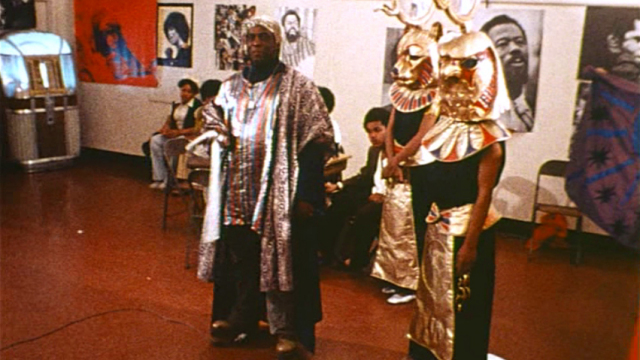


The film’s strengths included Ra’s genius musical skills. With a complex, at times disjointed, storyline (i.e. cosmic card games, 1940s jazz club vignettes, and proselytizing at an inner city youth center), Space is The Place features Ra’s 12-member band, the Arkestra. Clearly heard and on occasion seen in the film, the band melds heavy, kinetic percussions, an electrifying synthesizer, flamboyant horn, and a brass section that elevate jazz to a new dimension. For some, the music may not be enough to stay engaged with the plot. Much like how Sun Ra was difficult to understand and grasp, Space is The Place incorporates that confusion with a small opening of clarity. The film is a brilliant statement that informs audiences about 1970s race.


Space Is The Place is fundamental viewing, particularly for those interested in jazz or African/African American-diasporic cinema. Despite poor distribution and few theater screenings, the 1950s and 1960s futuristic acid jazz soundtrack made the film an underground classic.

Although this is Ra’s only film (honestly, he only needed one to preach his philosophy) he also made strides in the academic arena. Prior to the film, in the Spring 1971 semester, Sun Ra served as an artist-in-residence here at UC Berkeley. He taught a course in the African American Studies department, “The Black Man in the Universe,” or “The Black Man in the Cosmos.” While in the Bay (particularly Oakland), Sun Ra caught the attention of film and television producer Jim Newman. Listening to Sun Ra's lectures makes it obvious that the course and the Arkestra band influenced the film. Ra’s teaching style consisted of lecture for the first part of the class, then treating the students to keyboard solos or perhaps Arkestra performances for the second half: the epitome of an informative and engaging class. Watching and listening to him push the envelope is truly a cosmic experience.

More than just a dark, super-sonic bootleg 85-minute film, Space is the Place is a filmic vision laced with Ra’s musical talent, which sought to expand the consciousness of African Americans in Oakland’s hoods. Combining elements and references from the King James Bible, Afrocentrism, science-fiction, occult philosophy, Egyptology, and his own “Arkestra” band, Sun Ra created futuristic free jazz while telling a story of empowerment and survival. Space is The Place is a timely film that incorporates amiable silliness while examining race relations blended with radical paranoia, all in the context of the Black Panther movement and the post-Vietnam era. Space is The Place is an enjoyable, imaginative film with a dramatically unique plot.


*As posted in The Berkeley Graduate

Thursday, April 3, 2014

New Documentary Alert: “Invisible Universe: A History of Blackness in Speculative Fiction”


Utopian Fiction…What is, “Speculative Fiction?”…Who is part of the Science Fiction world?...What does it mean to be a “Second Class Citizen”?…A voyage into a fantastical world…

To answer some of those questions and expound on the above ideas, filmmaker and producer M. Asli Dukan’s has launched her documentary “Invisible Universe: A History of Blackness in Speculative Fiction” which investigates the relationships between the Black body, popular fantasy, horror, science fiction literature & film and the alternative perspectives produced by creators of color. According to Dukan:

From the origins of the genres, images of Black people in fantasy, horror and science fiction or speculative fiction (SF) have been inauthentic at best in the imaginations of white creators. From the “Fantastic Voyages” of the 1700s where Black pirates kidnapped white explorers to far off “alien” lands, to technologically advanced futures where Black people didn’t exist in any significant population, to post-nuclear holocaust America where modern Blacks took on aggressive pre-civilized behaviors, many of these ideas have created lasting impressions in the minds of their audiences and future creators. And though there were a few attempts by some white writers to use the genres for social commentary, for instance on race relations, these efforts were few and far in between.

There is however a significant output of work by Black creators, who used the techniques and themes of the genres to write alternative stories and to produce films that spoke closer to the realities of Black life. At the turn of the 20th century, Black writers wrote utopian and fantastical novels set during the days of slavery and Reconstruction. Independent Black filmmakers created low budget feature films exploring the effects of science and fantastical religious beliefs on the Black imagination. Harlem Renaissance writers jumped into the genre with “mad scientist” and “end of the world” scenarios commenting on the American race relations. In the 1960’s and 1970’s, two powerful and original voices emerged in the SF world writing tales with more inclusive pasts, presents and futures. Also in the 1970s, Black anti-heroes utilized science and the supernatural to secure Black justice. And later, there was the emergence of Black superheroes, who, though ready, willing and able to save the entire universe, first had to fight a homogenous industry.

This 10-year project brings these ideas to life through extensive footage, which features interviews with major writers, scholars, artists and filmmakers (i.e. Samuel R. Delaney, LA Banks, Tananarive Due, Nichelle Nichols, Wesley Snipes). The documentary also explores various mediums such as comics, literature, film, and television by deconstructing stereotypical and archetypal images of people of color (primarily Black) within these genres. Dukan has traveled across the country documenting key conferences, conventions, panels, performances and other events of Black SF at The Studio Museum in Harlem in New York, The East Coast Black Age of Comics Convention and The Afrofuturist Affair in Philadelphia, the AstroBlackness colloquium in Los Angeles, the Auburn Avenue Research Library on African American Culture in Atlanta, The Central District Forum for Arts and Ideas in Seattle, and New York Comic Con and Comic-Con International in San Diego. Essentially, “Invisible Universe” ultimately uncovers how Black and other individuals of color have been minimized and even erased within “popular” Sci-Fi culture, thus as a result of this consciously creating their own universe.

Dukan explains much of her dedication and efforts for this highly anticipated documentary project with a few words from the late, great Black science fiction writer Octavia Butler, “ I was trying to write myself in.” And Dukan does just that with “The Invisible Universe” documentary.

So if you would like to learn more and support the campaign check out the link HERE .

Check out the trailer here:

Invisible Universe trailer (Documentary feature work-in-progress) from Mizan Media on Vimeo.

As posted in The Berkeley Graduate

Wednesday, February 12, 2014

Afrofuturism: Reimagining the Past, Present, and Future


“In Afrofuturism is an exploration and methodology of liberation, simultaneously both a location and a journey.” ~D. Denenge Akpem ”


So what is Afro-Futurism? Music critic and writer Mark Dery (1994) coined the term to describe the self-conscious appropriation of technological themes in Black popular culture, particularly in rap and other hip-hop modalities. The term is more than just being “weird” or following different trends, but it is, as sociologist Alondra Nelson says, “to explore futurist themes in Black cultural production and the ways in which technological innovation is changing the face of Black art and culture” (Nelson & Miller, 2006). The appropriation of science and technology by marginalized groups (Eglash & Bleecker, 2001). As a whole, Afrofuturism is a free space that allows the option to explore, imagine, and discover Blackness tangent to science and technology. Afrofuturism, much like cyberfeminism, uses science fiction and cyber culture in a speculative manner to escape the traditional definitions of what it means to be Black or African (in exotic terms) within western culture (Bristow, 2012).
This week at Loyola Marymount University in Los Angeles, I had the opportunity to take part in a 2-day colloquium called “AstroBlackness: Remaking and [Re]Mixing Black Identity Before, Now, and Beyond.” During this colloquium writers, artists, filmmakers, and scholars worldwide are coming together to discuss Afrofuturism from various angles. The colloquium serves as a “space” where the intellectual, creative, literary and even visual expressions of “the black experience” are examined through the prism of Afrofuturism, in a manner that is both abstract and plausible and no longer dominated by monolithic tropes perpetually tied to an urban landscape or exclusively earthbound. The first day's topics and panels included The Black Imagination: Issues and Ideas of Afrofuturism as an Aesthetic; Science Fiction and Race; and Comic Books, Graphic Novels, Animation, and Afrofuturism.

In particular during the panel discussion on “Science Fiction and Race” many of the panelists such as Fantasy and Science Fiction writer Nnedi Okorafor would explain the many difficulties in maintaining the culture and race of their characters [i], while not allowing the narratives or characters be conscripted to “whitewashed” storylines. One question that would spark a huge debate from the panel and the audience dealt with whether or not Afrofuturism should be inclusive of everything that is outside of the box that is black and is sci-fi related. Some scholars such as University of California-Riverside’s Sherryl Vint felt that as a whole critics spend way too much time policing the boundaries of science-fiction, and not allowing it to be a free flowing entity. From its inception Afrofuturism and Science Fiction are genres that have always been unapologetically ‘outside the box’, but yet so many want to prescribe it to a particular formula. As Professor Reynaldo Anderson of Harris Stowe State University mentioned, “Afrofuturism, Science Fiction, Fantasy, and the Speculative [are] all about bending racial categories and rethinking these genres as forms of resistance.” Each of them serve as another transportation mode to a particular space, which allows for this creative resurgence of [astro]blackness on futuristic terms.

As for Day Two, topics from will range from Critical Literature and Radical Race in Science Fiction, to Gender and Race conversations and issues dealing with the Black Imagination and Science Fiction, and finally “The Future of the Afrofuture”. All in all, Afrofuturism continues to serve as this intersection between imagination, technology, the future, and liberation (Womack, 2013). As a genre it not only allows, but also encourages, individuals to unashamedly experiment, re-imagine identities, and activate this sense of liberation (LaFleur, 2011). Using these various avenues mentioned above, Afrofuturism continues to redefine Black culture and notions of Blackness for today and the future.
—————–
[i] Several creators and authors at the colloquium spoke about having to change the race of their characters, lightening their complexion, or adding non-black characters (i.e. white males), because the “higher ups” feel that audiences will not understand, it’s too political, or because it is so-called not marketable.  


References
  1. Bristow, T. (2012). We want the funk: What is Afrofuturism to the situation of digital arts in Africa? Technoetic Arts: A Journal of Speculative Research10(1), 25-32.
  2. Dery, M. (1994). “Black to the Future”. In Flame wars: The discourse of cyberculture. Durham, NC: Duke University Press.
  3. Eglash, R., & Bleecker, J. (2001). The race for cyberspace: Information technology in the black diaspora. Science as Culture10(3), 353-374.
  4. Nelson, A., & Miller, P. D. (2006, June 28). “About Afrofuturism”: Afrofuturism. Retrieved from http://www.afrofuturism.net/text/about.html
  5. Womack, Y. L. (2013). Afrofurturism: The World of Black Sci-Fi and Fantasy Culture. Chicago: Lawrence Hill Books.

G-Breezy's Favorite Movies

  • Bourne Identity/Supremacy/Ultimatum
  • Die Hard series
  • Do the Right Thing
  • Fracture
  • Idlewild
  • Imitation of Life
  • Inside Man
  • James Bond series
  • Love Jones
  • Malcolm X