Showing posts with label race. Show all posts

Thursday, February 12, 2015

Journey With Me to Sun Ra’s “Space is The Place”


“My whole body changed into something else. I landed on a planet that I identified as Saturn.” - Sun Ra

The Museum of African Diaspora (MOAD) and The Contemporary Jewish Museum recently held a 40th anniversary screening of jazz theorist and philosopher Sun Ra’s 1974 science-fiction cosmo-drama Space is The Place. In this complex, quasi-abstract, weird, militant Blaxploitation, visionary, Afrofuturistic, and hood-conscious film, Sun Ra takes viewers on a journey from space to Earth in hope of reclaiming Black minds using interstellar techniques, imagery, and Black Power consciousness colliding with the fashion sense of Shaft and Superfly.

The opening introduces us to a Black man dressed in head-to-toe Parliament-Funkadelic Egyptian regalia: Sun Ra. Coming from a bluish planet inhabited by Black people, he makes his entrance on Earth a spaceship evocative of a rubber raft with two blood-shot red eyeballs plastered on it. Sun Ra’s purpose for coming to Earth is to recruit more potential Black occupants, and spread a few philosophical lessons. His purpose becomes clear with his initial question: “Are you ready to alter your destiny?”

Sun Ra meets many challenges trip to Earth, ranging from a deferential reporter, to some teenagers who question his own existence: “How do we know you’re for real?” and dismiss him as “some old hippie” from Telegraph Ave.

Challenged in reclaiming the African and Black consciousness of his future inhabitants, Ra faces his greatest foe in his quest of freedom and liberation in the power structure that takes the form of “The Overseer” and his minion Jimmy Fey. The Overseer is a diabolical pimp and incarnation of evil in the Black community, in many ways a metaphor for the overseers from the U.S. slave trade, and Jimmy is reminiscent of present day Blacks trying to make it in the entertainment industry at any cost. As a ploy, The Overseer poses himself to be a community leader and a man of charity, while in fact being the tool of a dominant elite, hierarchal organization. In addition, to facing The Overseer, Ra must also combat White government agents (presumably from the FBI) who are attempting to eliminate him. From both racial angles, Black and White, Ra must fight to the death for the fate of the Black race.
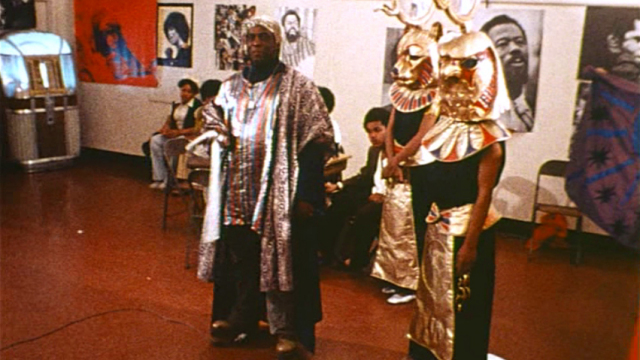


The film’s strengths included Ra’s genius musical skills. With a complex, at times disjointed, storyline (i.e. cosmic card games, 1940s jazz club vignettes, and proselytizing at an inner city youth center), Space is The Place features Ra’s 12-member band, the Arkestra. Clearly heard and on occasion seen in the film, the band melds heavy, kinetic percussions, an electrifying synthesizer, flamboyant horn, and a brass section that elevate jazz to a new dimension. For some, the music may not be enough to stay engaged with the plot. Much like how Sun Ra was difficult to understand and grasp, Space is The Place incorporates that confusion with a small opening of clarity. The film is a brilliant statement that informs audiences about 1970s race.


Space Is The Place is fundamental viewing, particularly for those interested in jazz or African/African American-diasporic cinema. Despite poor distribution and few theater screenings, the 1950s and 1960s futuristic acid jazz soundtrack made the film an underground classic.

Although this is Ra’s only film (honestly, he only needed one to preach his philosophy) he also made strides in the academic arena. Prior to the film, in the Spring 1971 semester, Sun Ra served as an artist-in-residence here at UC Berkeley. He taught a course in the African American Studies department, “The Black Man in the Universe,” or “The Black Man in the Cosmos.” While in the Bay (particularly Oakland), Sun Ra caught the attention of film and television producer Jim Newman. Listening to Sun Ra's lectures makes it obvious that the course and the Arkestra band influenced the film. Ra’s teaching style consisted of lecture for the first part of the class, then treating the students to keyboard solos or perhaps Arkestra performances for the second half: the epitome of an informative and engaging class. Watching and listening to him push the envelope is truly a cosmic experience.

More than just a dark, super-sonic bootleg 85-minute film, Space is the Place is a filmic vision laced with Ra’s musical talent, which sought to expand the consciousness of African Americans in Oakland’s hoods. Combining elements and references from the King James Bible, Afrocentrism, science-fiction, occult philosophy, Egyptology, and his own “Arkestra” band, Sun Ra created futuristic free jazz while telling a story of empowerment and survival. Space is The Place is a timely film that incorporates amiable silliness while examining race relations blended with radical paranoia, all in the context of the Black Panther movement and the post-Vietnam era. Space is The Place is an enjoyable, imaginative film with a dramatically unique plot.


*As posted in The Berkeley Graduate

Tuesday, February 3, 2015

Hollywood's Whitewashed Diversity*


With the award season fully underway, eyebrow have been going up over the lack of diversity in the recent Academy Awards nominations announcement. Immediately after the January 15 announcements, social media, Twitter in particular, went into a major uproar. The hash tag #OscarsSoWhite went viral after the Academy revealed that all 20 male and female contenders in the acting categories are white.
The Academy’s first black woman president, Cheryl Boone Isaacs, reported to New York magazine blog Vulture “that the organization does not have a diversity problem ‘at all.’” However, many fans, actors, and the like would have to disagree with this sentiment, considering the predominantly white list of artist nominations. This year’s Academy Awards is the whitest Oscars since 1998. Many people have expressed their frustrations as more disappointment than surprise, (i.e. CNN LA correspondent David Daniel “#OscarNoms No female directors, screenwriters, or cinematograhers. No actors of color. #diversity”) because this is neither the first, nor the second time that this has happened. In the last 30 years, the acting categories have been completely devoid of non-white nominees a total of five time (1989, 1992, 1996, 1998, and 2015). Though we supposedly live in a “post-racial” society, it seems the Academy has not received that memo.
This white-washing of the Oscars is quite significant, considering that one of the films snubbed, Selma only received two nominations: “Best Picture” and “Best Song” for Glory (John Legend and Common), without an actor or director nomination. Despite high marks from critics and having the best review for “Best Picture” (receiving a score of 99) of all the nominations, British actor David Oyelowo missed out on a nod for Best Actor for his powerful and chilling performance of Martin Luther King, Jr., and the Academy failed recognize the visionary young black Ava DuVernay in the “Best Director” category. Had DuVernay been nominated, she would have made history as the first ever black female to be nominated in that category. Films like Selma remind audiences how relevant and worthy of a discussion the film’s poignant subject matter is. Particularly in light of the unrest over the killings of Michael Brown and Eric Garner in Ferguson and New York, respectively, and even locally, echoing heavily on the American conscience, there’s a need for a film such as Selma to remind the country of what has happened and continues to happen…and how we still need change.
A year ago, it appeared as though the Academy had made some strides in diversity. 12 Years of Slave won “Best Picture” along with the ground-breaking win from Lupita Nyong’o in the Best Supporting Actress category. Additionally, Alfonso Cuaron was the first Hispanic man to win Best Director, while Chiwetel Ejiofor won “Best Actor” and Captain Phillips star Barkhad Abdi won “Best Supporting Actor”. Those seemed to be the major talking points, but this year, the nods made a drastic turn.

In response to this lack of diversity, many fans and actors took to Twitter to voice their support for fellow actors:
“So #OscarNoms hmm. Shout out to my brother #DavidOyelowo you’ve been robbed but you’re not defined by this and your talent can’t be taken.” ~ @NoelClarke


#OscarsSoWhite that even The Lego Movie didn't get nominated for Best Animated Film because Morgan Freeman voiced a character. ~ @ShaunKing
The significance of these awards has always been a controversial interest. Now some may argue that the Golden Globes was full of diversity, which is true; however, much of that diversity came from the television genre. Others have given up hope, realizing that waiting for the Academy to recognize diversity and talent may be an infinitely long wait. Since the Academy’s birth, African Americans have had a complex, abstruse relationship with the Academy Awards. Whether they are nominated for roles such as boxers, sharecroppers, drug addicts, abused or scorned women, welfare mothers, maids, psychics, drug dealers, prisoners, or simply not nominated at all, there is hardly an amicable relationship.
Although it is hard to ignore the righteous anger, one can’t help but ask: do actors, actresses, and directors really need the Academy’s approval of their acting talents and gifts?
*As seen also in The Berkeley Graduate

Thursday, October 16, 2014

A Sneak Preview into the Highly Anticipated “Dear White People” film*

“Dear White People, the minimum requirement of black friends needed to not seem racist has been raised to two…Sorry, your ‘weed man’ Tyrone does not count!”


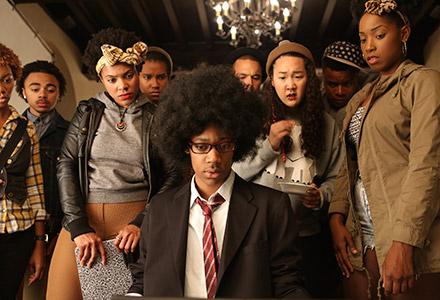
Every generation has a film that shocks as it touches upon issues of race and inequalities of color. In 1950, we had the black-and-white American film noir No Way Out; in 1970, the satirical comedy Watermelon Man; in 1989, Spike Lee’s ‘fight the power’ film Do The Right Thing (1989); John Singleton’s 1991 classic Boyz in the Hood; and at the beginning of the new millennium Bamboozled (2000). In 2014, we have Dear White People a contemporary satire that is not simply another post-black film, but a commentary on expanding and updating notions of black identity.
Winner of the 2014 Sundance Film Festival’s Special Jury Award for Breakthrough Talent, Dear White People is a sly, provocative satire of race relations in the Obama age. In this breakthrough performance, writer/director Justin Simien gives audiences a close look at four African American students as they navigate racial and sexual politics and campus life at the predominately white Winchester University. The four protagonists, “The Rebel,” “The Token,” “The Poster Child,” and “The Diva,” are what Simien likes to call “archetypes of people of color.” He sees them as archetypes versus stereotypes, or just simply blacks who espouse survival tactics in environments where they are in the minority or have to cope with the way people label them: “One of the things that was interesting about Dear White People is that I show these archetypes in the beginning, and we just dismantle them to a complete pulp by the end,”[1] remarks Simien.

Simien, a 31-year-old Texas native, drew direct inspiration for this film as result from his experience at Chapman University in Southern California. Being a “black face in a white place” is not just the premise of the film, but also an actual lived reality for Simien (the Black student body on Chapman University comprises 1.6 percent of the campus). As someone who has experienced much of what he portrays in the film, Simien takes a tongue-in-cheek approach to exploring the state of college campuses today and racial identity in a supposedly post-racial America, specifically, having a cinematic dialogue about what it means to be black today. Considering the past few years have been marked with numerous deaths of unarmed young black women and men, he has hopes that this film will resonate particularly with the millennial generation. According to Simien in an interview with “Best of New Orleans:
“The funny thing is that there are still people out there who believe [the U.S. is post-racial]…People say ‘do we even need this [type of film]? Aren’t we beyond this?’ After Obama was elected, there was this post-racial bubble; some liberal and very well-intentioned people thought we had overcome the struggles of racism. It took all these tragic shootings of black teenagers, and members of Congress telling Obama to go back to Africa, and racist blackface parties to bubble into mainstream for people to realize we’re still dealing with the same issues.”[2]
The film has garnered much anticipation leading up to its October 24th nationwide release, since one can view a collection of sketches, trailers, and videos under a PSA series called “The More You Know (About Black People)” some of these include:
             “Not To Be Racist, But…”     
            “Do Black People Love Fried Chicken?”     
In addition to the PSAs, sketches, and trailers, one can purchase Dear White People paraphernalia, posters, and even the book on which the film is based.
Dear White People hopes to bring laughs, while deliberately addressing casual racist attitudes of what may seem outlandish to some white Americans; for far too many African Americans, these statements represent everyday reality. For all intents and purposes, Simien wants viewers to walk out of theater with a different mindset from the one they brought into the film, and hopefully for the better. “I’m really looking at people whose past racial bubble is yet to be popped…I want this to be part of a cross-cultural conversation they’ve never had before. Our movie couldn’t have come out at a better time.”[3]
Dear White People hits select theaters this Friday October 17th and nationwide on October 24th. However, as a special bonus for the Bay Area there will be a private screening of this film on today at Shattuck Cinema Theaters.

*As posted in The Berkeley Graduate
--------
[1] Interview from New York Times “Happy to Be Your Guide to Black Identity”: Justin Simien Goes Mainstream with ‘Dear White People’…10/9/2014…By: Nelson George
[2] Interview from Best of New Orleans, “Director Justin Simien talks about Dear White People”
[3] Interview from UPTOWN Magazine, “The One Thing ‘Dear White People’ Director Justin Simien is Sorry About”…10/13/2014…By: Angela Bronner Helm

Sunday, August 18, 2013

The Butler...A Good film that serves a "two-face" purpose!!

"It is a peculiar sensation, this double-consciousness, this sense of always looking at one's self through the eyes of others, of measuring one's soul by the tape of a world that looks on in amused contempt and pity. One ever feels his two-ness, --an American, a Negro; two souls, two thoughts, two unreconciled strivings; two warring ideals in one dark body, whose dogged strength alone keeps it from being torn asunder." 

As I left the theater, I would be immediately reminded of the above statement from DuBois and his concept of double-consciousness along with the "veil". To live in world where you must decide how you must live your life according to others is quite a powerful thing. Interestingly enough The Butler, to a degree, explores that by presenting a story that evokes many of these complex feelings and experiences.

Based on the real-life account of butler (eventual Maitre-d'hotel) Eugene Allen, we are given the opportunity to travel through the years with the fictional Cecil Gaines (and his 34-year tenure in the White House) as he was able to eyewitness numerous high-profile events of the 20th century. Historical events such as the integration of Central High School in Little Rock, Arkansas, the Freedom riders, Nashville sit-ins, JFK assassination, Voting Rights Act of 1965, MLK and Malcolm X assassination, the Black Panther Party, the Vietnam war, Nixon resignation, Apartheid and South Africa, to the 2008 Barack Obama presidential campaign and election are all highlighted in this film furnishing a climatic backdrop to the life of this "pantry man" turned butler. Knowing this, The Butler is a unique historical drama film that everyone should see and personally determine for themselves what and how much of an impact it has on them. Many will leave the theater in tears, many may leave encouraged, discouraged or and/or angry, and others may leave with the intent to do better. Whatever the case may be the film serves its purpose.

The Butler is more than just about a man who is privy to many things, but it also tells a story of how this position affected him positively and in some ways unfavorably. In this position, Gaines demonstrates how one sometimes has to sacrifice their own self, family, personal feelings, and beliefs in order to enjoy the "good life" for the greater good. But then one asks the question, at what cost? Oftentimes during the film there were many eyebrow raising and awkward moments that although minor still stood out for me. Everything from parent relationships, finding love, fighting for the cause, and more are topics discussed in the film. And it's these little details that can make a film good or great! I always find it interesting the amount of attention certain movies get, such as The Butler. In a way, it is good to see more films discussing these pivotal individuals and the events connected to them, but there has to be more. Audiences have become quite familiar with the brutality, horror, victimization, and torture of African Americans, to the point of no return. So one has to ask what about the resistant/radical fighters, the risk-takers, and the stories that are buried even deeper and also not found in the typical textbook?


But I digress...So as I watched the film, I definitely must applaud writer Danny Strong and director Lee Daniels for bringing this story to the screen. The role of the butler is actually very important and I'm sure hits very close to home for many people, including myself, as I had several family members who took on this role as a job. To be in a position such as the butler and/or maid, this not only demanded much of one's time, but also having to wear the veil that we so often try step in front of (versus stand behind). Thus, The Butler is a film that has "two-faces", one of how to cope in a patriarchal, white world and the other of being competent but primarily invisible. It's all about the choices that you make and the consequences that follow. As mentioned earlier, for those who watch the film, one will find that every person has their own personal impact. This film was full of emotional intentions...to make you critically think, cry, laugh, fight back and appreciate.

In addition to a compelling and inciting plot, The Butler also presents a star-studded cast of actors and actresses. However, with this all-star cast there were some hits and some misses. Let me first say I appreciate how the film introduces us to Cecil's parents, so that we can have a foundation as to why Cecil becomes the man that he becomes throughout the film. However, my one complaint is who is set to play certain roles. Kudos to David Banner for this role as Earl Gaines (Cecil's father), although brief it was definitely poignant. On the flip side, there is the character of Hattie Pearl (played by Mariah Carey) who also has a short appearance, but a powerful one. I appreciate Daniels including this character in the film, however it was just his choice of who played the role. Not sure of Carey's significance, but nonetheless the character was needed. In a sense, it provides a backdrop to the future parent-child relationship that we would see in the rest of the film. Then you have leading man Cecil Gaines (played by Forest Whitaker) who does a formidable job in this portrayal. It's almost like he plays a "quiet storm". Whitaker truly embodies the understated role of Cecil Gaines and his struggle to survive in a world the uses him only when needed and necessary. With each film, he just gets stronger and better as an actor. I would be surprised if the Oscar buzz does not hit his radar. As a whole, Whitaker gave a brilliant and provocative performance that demanded your attention. And at the same time showcasing the sensitivity and humanity of the character.  Now the character that really got my attention was Oprah Winfrey's portrayal of Gloria Gaines. This was definitely one of the top highlights of the film for me. Oprah presented the many layers of this character inside and out. She truly embodied the role inside and out. You feel her pain, you empathize with her, and you see how she humanizes the role of wife and mother. In essence, Gloria plays this "bridge builder" and voice of reason, which is a very important element to the film. Quiet as kept she comes very close to almost stealing the movie with her touching performance. And the two sons in the film (Louis and Charlie Gaines) also played an important role as they were great examples of the dual sides of a father-son relationship. David Oyelowo should be once again commended as he plays the eldest and more radical son Louis. His role in particular teaches us how pride and stubbornness can sometimes be the demise of many relationships. 


In addition, there are definitely some more folks who should be complimented for their role in the film. Yaya Alafia (DaCosta) does a great job as Carol Hammie, a student activist and Louis Gaines girlfriend. Her growth as an activist is unique in that one significant event can affect you for the rest of your life. Alafia is definitely proving herself worthy, and definitely someone to not sleep on. Also Terrence Howard (who plays Howard) gives the viewer the element of what means to be a "two-face and no good". Other supporting characters such as Cuba Gooding, Jr. and Lenny Kravitz, who played Gaines friends and fellow butler colleagues, also provided another lens as to the camaraderie of domestic workers (in and outside the work place), as well as what it was like to work in the White House. It was also good to see Pariah's Pernell Walker (Lorraine) make several appearances through out the film, good to know work is still coming in for these up and coming actresses/actors. There would also be an interesting line-up of the presidents and first ladies, including Robin Williams (as Dwight Eisenhower), James Marsden (John F. Kennedy), Liev Schieber (as Lyndon Johnson), John Cusack (as Richard Nixon), Alan Rickman (as Ronald Reagan) and Jane Fonda (as Nancy Reagan). All in all, this was definitely a strong cast that proved worthy of watching them on the big screen. 

I will say this going into this film, I was on the fence especially after seeing the various movie posters and watching the trailer. I was not sure how this was going to turn out considering the HUGE FAIL from The Help, but it actually turned out better than I expected. As a whole, the acting was good, but there were some areas that just needed that extra push. As a current doctoral student in African American Studies, I would notice certain historical flaws/inaccuracies (regarding the role of the butler, some of the presidents, and various events), but nothing so damaging that it does not warrant viewing the film. At moments it felt rushed to cram a lot of history in one sitting. I appreciate the effort, it just needed to be teased out a little more, focus more on some things and less on others. Although not an epic film, it does present another story that might otherwise be swept under the rug, glossed over, and forgotten completely.

Overall, The Butler served its purpose as an inspiring, entertaining flick for the summer. Many lessons can be taken from the film such as sacrifice, dedication, the struggle, and family. I will say it again, it's a film that you take at face value, each person has their own personal impact some with the extra bells and whistles, other no. When it is all said and done this is only one account of someone's life, and trust and believe there are many more.


Rating: 7.5 out of 10

G-Breezy's Favorite Movies

  • Bourne Identity/Supremacy/Ultimatum
  • Die Hard series
  • Do the Right Thing
  • Fracture
  • Idlewild
  • Imitation of Life
  • Inside Man
  • James Bond series
  • Love Jones
  • Malcolm X