Wednesday, May 28, 2014

In Memory of Sista Maya Angelou... (Rest in Paradise)


Words just cannot expressed the sadness that would enter into my body upon waking up this morning to the news of the passing of a giant, Maya Angelou. Every word that left her mouth was truly immortalized and will always be cherished forever. As I thought about writing a post, I contemplated how I could honor the legacy of this great human being. I figured her words have truly had an impact in so many ways, particularly within the pop culture realm.

And as someone who consumes many elements of popular culture both academically and socially, I had to creatively pay my respects to this legend. So what better way to pay tribute than to highlight some clips of her words that  have been featured in various films, songs, television shows, etc....

Poetic Justice (1993) "Alone" and "Phenomenal Woman"


Maya Angelou and Common have a talk...


Maya Angelou and her conversation with Tupac Shakur...


"On the Pulse of the Morning" (1993) (President Bill Clinton Inauguration)


A conversation with Maya Angelou and Dave Chappelle...

In addition, on today in honor of Angelou XXL Magazine would feature a cadre of hip hop songs that mention/include Maya Angelou in some sort of fashion...

1) Common feat. Maya Angelou "Dreamer"
"Once you find your shoulders dropping/And your speech gets slow and hazy/You better change your way of being/Before you found your brain got lazy/You can build a better future when you join the winning team/If you desire a bright tomorrow, you must build a brighter dream" —Maya Angelou

2) Wale "The Artistic Integrity"
"Maya Angelou spawn/ Abandoned and raised by Nas/ Raised by the sharks but I'm swimming with the prawns/ I found my own lane/ Meet Mr. Folarin"

3) Lupe Fiasco "I'm Beamin'"

"Mix Melissa Ford/With Maya Angelou/Become a top model/And Sojourner too"

4) Jean Grae feat. Pharoahe Monch "Killin' Em"

"Word evangelist/Diabolical vandalist/Infamous/Maya Angelou with Marlon Brando shit" —Jean Grae

5) The Roots "The Session (Longest Posse Cut in History)"

"So okey-dokey folks/Most provoke me I'll choke ya so hold your oats/Was rollin' 'cause I'm strollin' with the quotes/Like Shakespeare, Mark Twain, or Edgar Allan Poe/But since I'm a negro, I flows like Maya Angelou" 

6) Dilated Peoples feat. Defari

"I'm on that Richard Pryor, Bruce Lee, Muhammad Ali/Bob Marley, Jimi Hendrix, Salvador Dali/Now we rap Langston Hughes and Maya Angelous/Out the disco Xanadu/Hip-hop for the streets" —Rakaa Iriscience

7) Kanye West "Hey Mama"

 "Can't you see?/ You're like a book of poetry/ Maya Angelou, Nikki Giovanni/ Turn one page and there's my mommy"

8) Nas "The Makings of a Perfect B@%$#"

"Gimme Sade's mystique, she gotta know her way in the streets/ Like Billie Holiday in Harlem/Body from Ki Toy Johnson and Kenya Moore and Apple Bottoms/ Maya Angelou's brain and some groove from Terry McMillan"

9) Talib Kweli feat. Kanye West, Busta Rhymes, Mos Def, and Jay-Z "Get By (Remix)"

"It's something about that Nina Simone piano flow/ It's like a Michaelangelo painted a portrait of Maya Angelou/ And gave it to a sick poet for they antidote/ If music get's you choked up this is the tree and a rope" —Kanye West

10) Wale feat. Meek Mill, Pill, Rick Ross and Teedra Moses "Self-Made"

"Picture me rollin', young, handsome and focused/Got that vision of 'Pac although I'm branded as Oprah/Michelangelo portrait meet Maya Angelou notebook/Michael Jordan performance nigga I'm picturing all of it" —Wale

Amazing how much of an impact a few words can have on a society, community, and even the world! The ancestors await you Sista Angelou!


Thursday, May 1, 2014

Brick Mansions*

Brick Mansions is a French-Canadian action movie that is based on the 2004 French film District 13. This action thriller is directed by Camille Delamarre and written by Luc Besson, Robert Mark Kamen, and Bibi Naceri. The film stars Paul Walker (Fast and Furious franchise), David Belle (District 14, Ultimatum), RZA (Repo Men, Ghost Dog) Catalina Denis (Taxi 4, Le Mac), and Robert Maillet (Sherlock Holmes, Pacific Rim). This is one of Paul Walker’s final roles before his untimely passing on November 30, 2013.
It’s the year 2018 and a dystopian Detroit has fallen on hard times. Brick mansions have become dilapidated, a rise in drug-related crime, and community residents are left to suffer. At the core of its problems, at least according to the politicians, is how to get rid of this building structure and everything within it. Unable to control the crime, the police under the leadership of the mayor have a constructed a massive containment wall around the neighborhood in order “to protect” the rest of the city. This becomes not just a plan of action, but also the problem.
Now as for the residents of Brick Mansions, there is a unique blend of sophistication, humor, and seriousness that we see in the cast members. Lino, one of the protagonists who is played by French actor and Parkour creator David Belle (he also starred in the 2004 original), is an ex-con who wants to protect the innocent residents of Brick Mansion from the thugs, criminals, and villains who are essentially regulating the streets. The other protagonist is an outsider, but insider of Brick Mansions: undercover Detroit narcotics detective Damien Collier (played by Paul Walker) who navigates this dangerous neighborhood in order to bring down a crime lord and his plot to devastate the entire city. Interestingly enough, this character is not a significant stretch from his previous well-known role in the Fast and Furious series. Then there is the “sheriff of Brick Mansions” Tremaine (played by Wu-Tang member RZA), a well-dressed, tough-talking kingpin, who may or may not be what he seems. Viewers are not quite sure where he stands in relation to the uplift of the community. Sadly, in the role of Tremaine RZA does not really provide a developed and quality performance.
One particular relationship worthy of attention is the one between Lino and Damien. Although it is a slow-building rapport, Lino and Damien seem to gradually get past their mistrust and effectively become a force to reckon with on screen. Despite the electrifying chemistry, at times Walker’s character is a bit stilted, off-kiltered and out of place next to Belle particularly during the fight scenes. However, they make a fine duo.
Despite not having an original storyline, the beauty of the film is the human body in motion. The clever interplay between characters is resourceful and engaging. And, since this is primarily an action film remake, most of the scenes are fast and enjoyable. The viewer witnesses the special military, gymnastic style of choreography known as ‘Parkour style’. As a result, these stunts and fight scenes are clearly the star of the film.
Additionally, although the film is primarily action-based and may be difficult to take seriously, there are some significant takeaway moments that can be identified:
  • Social and political commentary on the ramifications of social inequality
  • Elite power structures taking advantage of the innocent and poverty-stricken
  • Humanity for all regardless of the person’s status and/or situation
Needless to say, unfortunately one of the down sides of the film is that instead of the original six month time window depicted in the original District 13, the writers attempt to cram the exact same story into 48-hours without any nuanced changes. There is also a heavy dose of violence, expletive language, and situations of menace and peril (particularly for a film that is rated PG-13), which on several occasions are over the top. Some moments I felt like I was playing “Grand Theft Auto” the video game. Essentially, Brick Mansions is an impatient remake with an underdeveloped narrative, shallow and clichés villains, and thrilling, but disconnected action scenes.
Overall, despite the film not being as climatic, production wise, as one might hope Walker still radiates the same charming, golden-boy effort in this posthumous release. Brick Mansionsdelivers a decent remake effort that will surely disappoint some and please others.

*As posted in The Berkeley Graduate

Thursday, April 3, 2014

New Documentary Alert: “Invisible Universe: A History of Blackness in Speculative Fiction”


Utopian Fiction…What is, “Speculative Fiction?”…Who is part of the Science Fiction world?...What does it mean to be a “Second Class Citizen”?…A voyage into a fantastical world…

To answer some of those questions and expound on the above ideas, filmmaker and producer M. Asli Dukan’s has launched her documentary “Invisible Universe: A History of Blackness in Speculative Fiction” which investigates the relationships between the Black body, popular fantasy, horror, science fiction literature & film and the alternative perspectives produced by creators of color. According to Dukan:

From the origins of the genres, images of Black people in fantasy, horror and science fiction or speculative fiction (SF) have been inauthentic at best in the imaginations of white creators. From the “Fantastic Voyages” of the 1700s where Black pirates kidnapped white explorers to far off “alien” lands, to technologically advanced futures where Black people didn’t exist in any significant population, to post-nuclear holocaust America where modern Blacks took on aggressive pre-civilized behaviors, many of these ideas have created lasting impressions in the minds of their audiences and future creators. And though there were a few attempts by some white writers to use the genres for social commentary, for instance on race relations, these efforts were few and far in between.

There is however a significant output of work by Black creators, who used the techniques and themes of the genres to write alternative stories and to produce films that spoke closer to the realities of Black life. At the turn of the 20th century, Black writers wrote utopian and fantastical novels set during the days of slavery and Reconstruction. Independent Black filmmakers created low budget feature films exploring the effects of science and fantastical religious beliefs on the Black imagination. Harlem Renaissance writers jumped into the genre with “mad scientist” and “end of the world” scenarios commenting on the American race relations. In the 1960’s and 1970’s, two powerful and original voices emerged in the SF world writing tales with more inclusive pasts, presents and futures. Also in the 1970s, Black anti-heroes utilized science and the supernatural to secure Black justice. And later, there was the emergence of Black superheroes, who, though ready, willing and able to save the entire universe, first had to fight a homogenous industry.

This 10-year project brings these ideas to life through extensive footage, which features interviews with major writers, scholars, artists and filmmakers (i.e. Samuel R. Delaney, LA Banks, Tananarive Due, Nichelle Nichols, Wesley Snipes). The documentary also explores various mediums such as comics, literature, film, and television by deconstructing stereotypical and archetypal images of people of color (primarily Black) within these genres. Dukan has traveled across the country documenting key conferences, conventions, panels, performances and other events of Black SF at The Studio Museum in Harlem in New York, The East Coast Black Age of Comics Convention and The Afrofuturist Affair in Philadelphia, the AstroBlackness colloquium in Los Angeles, the Auburn Avenue Research Library on African American Culture in Atlanta, The Central District Forum for Arts and Ideas in Seattle, and New York Comic Con and Comic-Con International in San Diego. Essentially, “Invisible Universe” ultimately uncovers how Black and other individuals of color have been minimized and even erased within “popular” Sci-Fi culture, thus as a result of this consciously creating their own universe.

Dukan explains much of her dedication and efforts for this highly anticipated documentary project with a few words from the late, great Black science fiction writer Octavia Butler, “ I was trying to write myself in.” And Dukan does just that with “The Invisible Universe” documentary.

So if you would like to learn more and support the campaign check out the link HERE .

Check out the trailer here:

Invisible Universe trailer (Documentary feature work-in-progress) from Mizan Media on Vimeo.

As posted in The Berkeley Graduate

300: Rise of an Empire*

[Trigger warning: review contains reference to sexual assault]
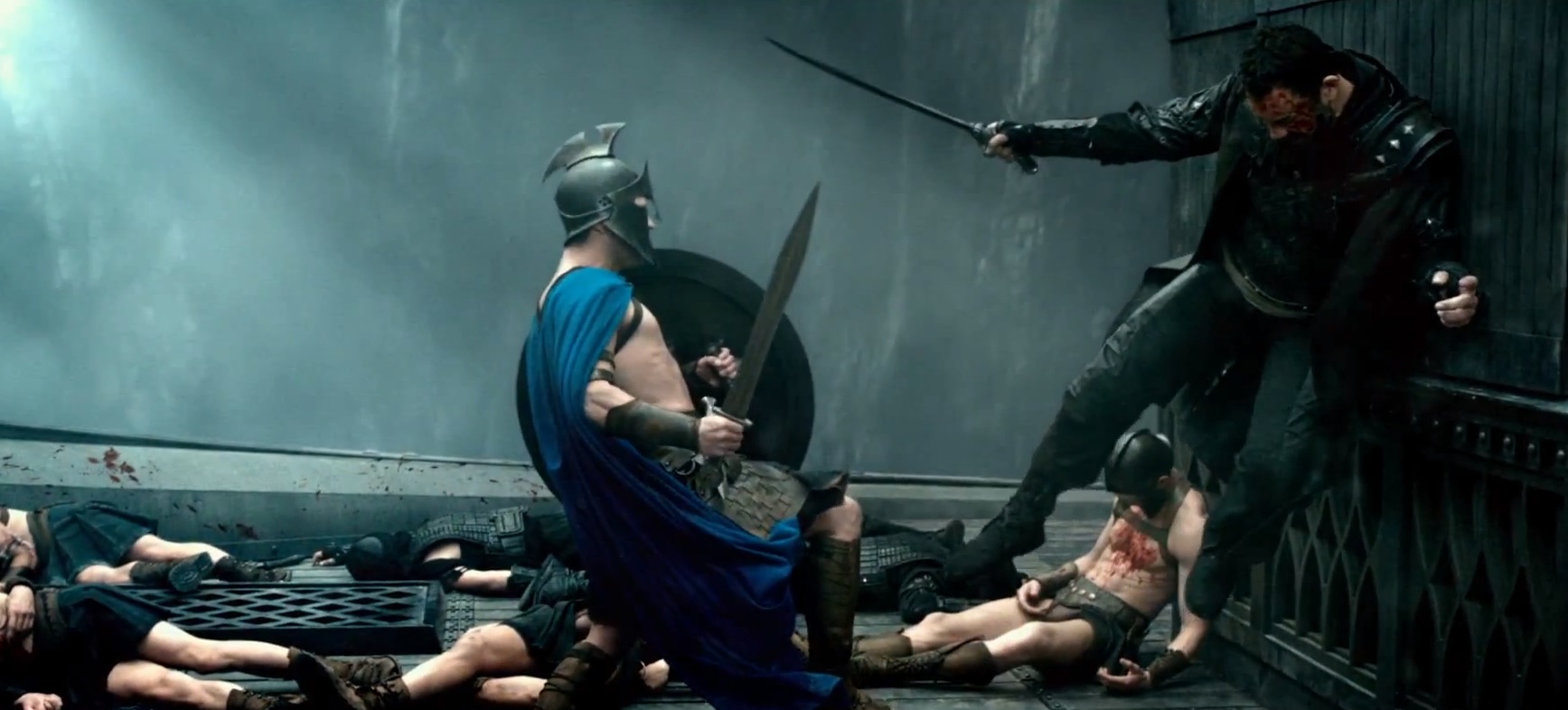
Seven years since the release of the 2006 fantasy, action-packed film 300, audiences are presented with the prequel and sequel 300: Rise of an Empire, which tells the story of Greek general Themistokles who leads the charge against invading Persian forces that are led by mortal-turned-god Xerxes and Artemisia, vengeful commander of the Persian navy. The events in the film are happening before, concurrently, and afterwards of the previous film (300).
300: Rise of an Empire quite possibly might be better than the first. As a whole, the story is more or less the same – Persians invading Greece for an impending takeover. However, the focal point for this second film is the Persian army specifically seeking to destroy the city of Athens and its people. Unlike the men of Sparta (who are equipped with a perfect set of abs and muscle ripped body), the soldiers come in various sizes and builds and are not nearly as “exotic” in appearance.  Much like the first 300, there are the free flowing fight scenes, choreographed to be reminiscent of a flawless dance routine. Nonetheless, the difference in approach between the two films is found in the nefarious nature of the second; by comparison, the first had a far more romantic predisposition.
To some viewers, 300: Rise of an Empire might be a little different from what one might initially expect. Rather than a simple sequel, it is more of a companion movie – incorporating various viewpoints of previous events in 300 in addition to events during and after. I found the narrative/storyline to be quite compelling and provocative. For example, the Persians are still attacking Greece, but this time the audience is getting the story from the viewpoint of Athenian Themistocles, while the events of 300 unfold elsewhere. As a bonus, the film also reintroduces the backstory of some old and introduces us to several new characters that are very interesting to watch. These back-stories showcase some very stimulating and engaging battle scenes. With a plethora of fantastic battle scenes that take place on land, there are just as many extravagant naval battle scenes. Many of these awesome and entertaining battles ranged from the witnessing of explosive ships wrecks, to beheadings, and well-choreographed one-on-one sword fights. Watching Themistocles engage in naval tactics was particularly thrilling. Certain scenes of combat were actually much better than the first 300–more abrasive, rougher, and just more fun to watch.
Much like the first, 300: Rise of an Empire is visually enticing and aesthetically dark and beautiful simultaneously. Overall, the characters are definitely clothed in typical Greek beauty/fashion, everything from the glowing, chiseled and toned bodies of the male soldiers, to the supple breasts of the women, to the poignant and graphic sprays of blood and body parts, essentially showcasing the bodies and scenery that are being put on display. Herein, this is where the movie really shines in the multifarious visual elements from both of the actors as well as in the special effects. Taking it a step further, the lighting is also quite exquisite as it worked in tandem with the story, both lent very well to the way in which the 3D and CGI were utilized. Instead of certain features “popping” out they rather take the approach of going deep within the film’s soul. Cinematographer Simon Duggan does an impressive job of mapping out the landscape (dark, grimy battlefield) and its correlation between the intensity of the film and how the Persian takeover (that happens on both land and sea) shown in the film is more of an insight to the original story, going deeper than Sparta and the army of 300.
Regarding the actors/actress of the film there are a few standouts. Eva Green (who plays Artemisia) executes an excellent portrayal of one of the main villains, her performance is quite compelling and to some degree is the “Leonidas” of Rise of an Empire. At times she is very terrifying, while nonetheless amazing to watch. One might say she holds her ground and can “roll with the big boys/men.” This is not to say that Sullivan Stapelton (Themistocles) is overshadowed but it is obvious that his role was intended to be more meticulous and precise, very much like how the Queen in 300 is portrayed. Although fighting on opposite sides (but of the same Athenian heritage), the two pull the differing sides of a war story firmly together. Not to mention the chemistry between the two in and out of each other’s presence is disturbingly orgasmic. For example, the sex scene is more sadomasochistic and less love making, borderline rape porn. Without giving any spoilers, this particular scene can be described in this way due to the gender power dynamics that are exhibited. Instead of Artemisia being the victim, she is depicted more as having the upper hand as this blood-thirsty, revenge-seeking dominatrix. The climax of that particular scene becomes a semi-civil talk between two enemies (who do happen to respect each other) that quickly becomes a discussion of surrender and rough-sex. If one recalls the passion between “King Leonidas” and his queen in300 is filled with intense affection and attachment whereas the scene in 300: Rise of an Empire is permeated with force, power and control.
Considering the historical acts that the movie is [loosely] based on, and the personality and writing of the creator [Frank Miller][1] of which the yet to be released graphic novel [“Xerxes”] is based upon the film is bound to includes acts of machoism, sexism, misogyny, etc. And although, the intention of the filmmaker is to entertain the audience, this entertainment is still simultaneously complicated and problematic. What is also unique and interesting about the gender dynamics is the fact the male performances are more at the bottom of “totem pole” and in some ways fall flat, whereas the two main female actresses dominate the film from numerous angles of power. Artemis (Green) is truly the one to watch in that without being over-sexualized she controls the screen with her skillful, graceful and strategic violence and sexuality. In a sense, she owns and advocates for her own body. All in all, on a few occasions, I as a viewer would be willing to die for her on the battlefield.
Furthermore, without delving too deep, but at least acknowledging it, the lack of historical accuracy may annoy or turn off some viewers. However, if you’re looking for that, this was not the movie for you. In many cases, movies that are based on comic books and/or graphic novels are not entirely accurate, nor do the creators aim to accomplish that goal. As a matter of fact, the first 300 was not 100% accurate, but still engaged and entertained the audience (their primary goal). By allowing the film to be an interpretation, this gives the writers and directors to have some sort of creative liberty.
All in all, the 300: Rise of an Empire was very enjoyable and satisfying. One could liken this viewing experience to an intricate, highflying roller coaster ride. In particular, the ending of the movie is very climatic and awe-inspiring as we are presented with the final battle scenes. When it is all said and done, 300 was ground breaking at the time of release in 2006, and300: Rise of an Empire fosters that first step into a world of a distinctive, and possibly more mysterious, way of storytelling.
Rating: 8/10
[1] In previous films such as “300”, Sin City, The Watchmen, Frank Miller is notoriously known for his misogynistic and hyper-sexualized treatment of women.


*As posted in the The Berkeley Graduate

Sunday, March 9, 2014

Black Girl Nerds: Best Villains: TV/Movies/Animated/Comics

Check me out w/my fellow Black Girl Nerds for today's ‪#‎BGNPodcast‬ on 
"Best Villains TV/Movies/Animated/Comics" 
Call us at 347-237-4616 to chat with us LIVE on the air! #BGNPodcast 7pm EST!

Thursday, March 6, 2014

Forest Whitaker stars in the new psychological thriller "Repentance" (2014)

Imagine a night of fun in the Louisiana bayou with family and friends that turns into a nightmare that you never forget…

Repentance, a psychological thriller, tells the story of life-coach and author Thomas Carter (played by Anthony Mackie), who is approached at a book signing for an autograph and one-on-one counseling mysteriously abducted by an unbalanced client, Angel Sanchez (Forest Whitaker). Against better judgment, Carter agrees to take on Angel as a new client, so that he can assist with paying off a debt for his brother Ben (played by Mike Epps). What Carter does not realize is that Angel has done his homework on the therapist as he delves into his teachings and uses his spiritual messages of Karma (Vipaka—action and reaction) against him to create “hell on earth” for Carter and his family so that they can own up to their past sins. Very quickly, the client becomes the judge and jury.

Repentance, directed by Philippe Caland, and stars Forest Whitaker, Anthony Mackie, Mike Epps, Nicole Ari Parker, and Sanaa Lathan. This 2014 picture offers viewers a front row seat to a deep, dark, twisted secret but, unfortunately, the journey to the film’s revelations is very anticlimactic. Just think of Repentance as a cross between MiseryWhat Lies Beneath, and Eve’s Bayou.  Repentance relays a failed effort at a psychological portraiture thriller film that just happens to throw in a few scenes of pointless tension and forced torture scenes. What the movie does well is provide the necessary (and, at times, overcompensated) shock and suspense of the genre.

As a whole, Repentance lacks in character development. Thomas turns out to be an inflexible, hypocritical, phony counselor and Angel (to no surprise) is essentially a second-generation, down-graded male version of Kathy Bates’ character in Misery. Then you have the secondary and minor characters Ben (Epps) who is more of a plot point than a character, existing primarily as the keeper of his brother’s dark secret; Maggie (Thomas’ wife; played by Lathan), a very minor role as an ungrateful, yoga instructor; and, finally, Sophie (Angel’s wife; played by Ari Parker) makes a very brief, short-lived appearance until more than halfway through the film. Basically, the female characters become nonentities and impassioned placeholders. 

Director Philippe Caland, a French-Lebanese immigrant, is a filmmaker with a unique career in Hollywood. He has done everything from producing to a few entrepreneurial efforts. Caland provides a momentarily intriguing film that could have had a compelling and riveting storyline, but falls to hit the mark. As an Academy Award winning actor Whitaker, who has much better roles and has worked with Caland before, (i.e. The Last King of ScotlandThe ButlerRepo Men) finds himself taking on a “wow-less” role in an implausible, far-fetched script. Obviously shot on a very small budget, both Caland and director of photography Denis Maloney fail to take advantage of the authentic New Orleans surroundings resulting in a boring, visual feature film.

All in all, Repentance becomes a film that is ultimately formulaic with a predictable, disappointing ending. Even with commendable performance from both Whitaker and Mackie, it’s not enough to carry the film to the finish line. At a certain point, the viewer quickly loses interest and must suffer through to the end.


Rating: 6.5 out of 10

As posted in The Berkeley Graduate

New Trailer Alert: "Annie" (2014)


The wait is finally over!!

Quvenzhané Wallis may have been an unknown when she was casted in the indie film Beasts of the Southern Wild, but her charming and glowing personality along with natural talent have placed her the leading role of the updated adaptation of the hit Broadway musical Annie.

Academy Award® nominee Quvenzhané Wallis (Beasts of the Southern Wild) stars as Annie, a young, happy foster kid who’s also tough enough to make her way on the streets of New York in 2014. Originally left by her parents as a baby with the promise that they’d be back for her someday, it’s been a hard knock life ever since with her mean foster mom Miss Hannigan (Cameron Diaz). But everything’s about to change when the hard-nosed tycoon and New York mayoral candidate Will Stacks (Jamie Foxx) – advised by his brilliant VP, Grace (Rose Byrne) and his shrewd and scheming campaign advisor, Guy (Bobby Cannavale) – makes a thinly-veiled campaign move and takes her in. Stacks believes he’s her guardian angel, but Annie’s self-assured nature and bright, sun-will-come-out-tomorrow outlook on life just might mean it’s the other way around.

The film stars are favorite lil Academy Award nominee, Quvenzhané Wallis as Annie alongside Jaime Foxx as Benjamin Stacks ( a remixed and up-to-date version Daddy Warbucks) and Cameron Diaz as Miss Hanigan.

Check out the trailer below:


Annie hits theaters December 19th. Just in time for the Christmas holiday!!

G-Breezy's Favorite Movies

  • Bourne Identity/Supremacy/Ultimatum
  • Die Hard series
  • Do the Right Thing
  • Fracture
  • Idlewild
  • Imitation of Life
  • Inside Man
  • James Bond series
  • Love Jones
  • Malcolm X