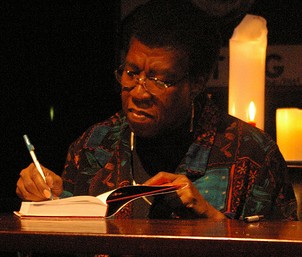
While doing my daily reading of Shadow and Act, I came across this very intriguing article discussing sci-fi writer Octavia Butler and possible/potential film adaptations. It was such an engaging article that I just had to do a repost on
Having just finished reading African-American science-fiction author Octavia E. Butler’s short story,” BLOODCHILD,” the temptation to adapt the work for the cinema brings forth a host of complexities within the material that go far beyond the race of the author. Ostensibly, BLOODCHILD is the story of human beings who have left earth, due to rising violence and the threat of enslavement, to share their lives on another planet populated by arthropod-like creatures.
The price for peaceful co-existence between the two species is that selected male humans must be impregnated and bear the children of the aliens in an excruciatingly painful and bloody gestation process. One male child has discovered that for all of his life he has been groomed for impregnation and if he refuses then the lives of his siblings and loved ones will be held in jeopardy.
In the afterword by the author, Butler makes explicit the themes and context of the story. She states that on one level BLOODCHILD can be read as,” a love story between two very different beings,” and that its context is that of,” a coming of age story in which a boy must absorb disturbing information and use it to make a decision that will affect the rest of his life,” and finally she confesses that,” Bloodchild is my pregnant man story.”(1)
Butler’s reason for explicitly detailing the themes and context in her afterword to the short story was driven by a central difficultly in the creation and critique of any science fiction by an African-American author: the certain tendency to see all science fiction by African-Americans as a metaphor or commentary about slavery or racial inequities past and present. As Butler matter-of-factly asserts,” it amazes me that some people have seen “Bloodchild” as a story of slavery. It isn’t.” (2)
Yet this overarching and obsessive need to see all science fiction by African-Americans as a metaphor or commentary on slavery or racial inequities tends to make the question of race a central theme within the work (whether it is actually there or not) to the exclusion of all the other prominent themes as Butler pointed out in her afterword to BLOODCHILD. In placing the racial frame upon the science fiction/fantasy/or futurist work of African-Americans we too hastily discard the genuine scientific, fantasy or futurist aspects of the work, which in turn, weakens and /or perverts the author’s original intent. In fact, many African-Americans use race as a default critique when we approach science-fiction solely as a means of side-stepping the science within the fiction no matter what the race of the author.
For example, many African-American film scholars (Ed Guerrero, Eric Greene, Adilifu Nama), critics and viewers insist upon reading Frank J. Schaffner’s PLANET OF THE APES (1968) as,” a dense racial allegory,” where a white male is,” a signifier of black victimization,“ that obscures the central scientific themes and historical source material of PLANET OF THE APES which were the 1925 Scopes trial, the concept of Darwin’s Theory of Evolution, and the concept of time dilation in space travel.(3)
Although later PLANET OF THE APES sequels did deliberately enhance the racial allegory with the saga, perhaps owing to the financial incentives of the Blaxploitation genre that was growing in popularity at that time, the original PLANET OF THE APES, adapted from French author Pierre Boulle’s 1963 novel by Rod Serling and Michael Wilson, is a stunning exploration of skepticism about the theory of evolution and the fear of knowledge that contradicts established beliefs in the face of mounting empirical evidence from an inverse perspective [that the superior apes are derived from the lowly humans]. These over-racialized readings of PLANET OF THE APES demonstrate how convincingly one can discard the “science” within the fiction to make the subject of race a central theme within any science fiction film or story.
Returning to Octavia E. Butler’s BLOODCHILD, her insistence that BLOODCHILD is not a story of slavery in her afterword is a direct consequence of the over-racializing of the work of African-American science-fiction authors as metaphors or commentaries on slavery or racial inequities. Neither Butler nor her characters in BLOODCHILD ever mention their race within the text. In effect, to see BLOODCHILD as a metaphor about slavery is to deliberately obscure the more profound and disturbing aspects of the work which is of course the notion of male pregnancy and a boy’s coming of age on an alien planet where the adults have made a political accommodation to peacefully co-exist with their alien hosts that has troubling moral, physical and psycho-sexual consequences.
This is the “science” within the fiction that cannot by itself prohibit a racial critique but it certainly reveals how using race as a default critique of science-fiction by African-American authors perverts their themes and chains these authors to the topic of race no matter how much freedom they have within their chosen medium of artistic expression.
For African-American filmmakers the over-racializing of the themes within a science-fiction story (whether an original story or adaptation) is ultimately inhibiting because those scientific, speculative or fantasy aspects that attracted you to the work in the first place can easily become obscured, diluted or discarded as “race” insidiously poisons the well of the fictional context and content. It is a poisoned well that makes us all potentially see the genre of science-fiction,” through a glass darkly,” so to speak. To put the matter plainly, the perceptual frame of racial inequality (past or present) can be applied to any story or film regardless of the author’s central themes; race is a catch-22; a prison house of interpretation from which it seems there is no escape or satisfying resolution.
For example, if you as a filmmaker omit African-Americans from the science-fiction story altogether then the critical concept of “structured absence” allows your critics to use any other non-white race, animal, or object within your film as a symbol of minority otherness and then “interpret” a racial commentary where you had not intended such a commentary to exist. One needs only to read Ed Guerrero’s devastating analysis of Joe Dante’s GREMLINS (1984) and GREMLINS 2: The New Batch (1990) in his book Framing Blackness.(4)
In regards to the absence of African-Americans in the GREMLINS films, Guerrero interprets the Gremlins themselves as symbols of minority otherness and asserts that,” the film’s socially repressed fears have to do with non-white minorities gaining political power, as Gremlins 2, satires the political subtleties of an increasing influential “minority discourse” in contemporary American life more than it plays upon latent anxieties over racial otherness.” (pg.65) Although it could alternately be argued that many White American filmmakers were omitting African-American characters from their science-fiction films in a naïve and erroneous attempt to avoid racial issues and keep those issues from stealing focus from their central themes.
Conversely, if you place African-Americans in lead, co-lead or supporting roles in a science-fiction film, the critics can use the concept of “token presence” to suggest that the actors are performing blackness as a general commentary on race relations (contemporary, historical or speculative) as author Adilifu Nama does with his analysis of Will Smith in Alex Proyas’ I, ROBOT (2004) in his book Black Space. In regards to more African-American actors gaining lead and co-lead roles in science-fiction films, Nama asserts that,” In the wake of September 11th, black representation in the science-fiction films of today may function to assuage an acute case of domestic paranoia.” (pg.40)
So that even with an African-American in the lead role of a science-fiction film the concept of token presence maintains race as a central theme to the exclusion of the “scientific” themes within the film. Idris Elba’s supporting role as the space ship captain in Ridley Scott’s PROMETHEUS (2012) can be viewed as a commentary on race if we are willing to sweep aside and obscure the film’s central themes on the origin of man, inter-planetary bio-warfare, and the old filthy rich miser who desperately wants to cheat death at the expense of the lives of others.
Token presence can also allow us to use Bokeem Woodbine’s supporting role in Len Wiseman’s re-imagining of TOTAL RECALL (2012) as a racial commentary that can obscure the compelling political and psychological themes that are central to the work of celebrated science-fiction author Phillip K. Dick upon which the film is based.
The full title of Nama’s book is revealing of the catch-22 of race: it is called BLACK SPACE: Imagining Race in Science-Fiction film. The title itself begs the question are we “imagining race” in science-fiction film as a means of obscuring the science and other themes that do not support a racial interpretation within the work? As a filmmaker approaching the science-fiction genre with the ambition of casting African-Americans in your film, you will have great difficulty in finding a middle ground between the racialized poles of “structured absence” and “token presence”. It would seem that as it concerns race in the genre of science-fiction, one is damned if you do and damned if you don’t cast an African-American.
“One of the most difficult obstacles African-American writers and filmmakers must face when approaching the genre of science-fiction is whether or not to continue the pessimism of present day racial inequities in their visions of the future or whether or not to project an optimism into their visions of the future where racial inequities have been solved. It is literally a choice between a dystopic future and a utopian future where racial conflicts have either been solved as in a utopia or remain unsolved as in a dystopia.
The most pertinent question that might help in making the choice is: Are blacks treated better, worse or fairly in the future than they are today? This choice is of great importance because if the racial inequities have been solved then the writer/filmmaker must find conflicts within the drama beyond race which given the narrow perceptual frame through which many African-Americans view cinema, might be no easy task.
For example, in director Ridley Scott and writers Dan O’Bannon and Ronald Shusett’s science-fiction film ALIEN (1979), racial inequities were carried forward into the future by the character of African descent named, Parker (Yapet Koto) who held a mechanical engineering job that was on a lower pay scale than the other whites on the interplanetary mining ship, Nostromo. A fact that can be understood from his concern about their bonus pay which he was told would be revoked if they didn’t fulfill their mission directives. Moreover, he was a subordinate in the chain of command to nearly all of the other whites on the ship besides his fellow white co-engineer, Brett (Harry Dean Stanton). Parker’s death at the hands of the violent space creature was made all the more tragic since he was killed in a futile effort to protect a weak and hysterical white female crew member.
By contrast, Brian DePalma’s MISSION TO MARS (2000) projects an optimistic future where racial inequities, it is at least implied, have been solved by the example of the Luke Graham (Don Cheadle) character’s unguarded interaction amongst his white peers and colleagues as well as his command of the first human colony on Mars. It is clear that an optimistic perspective brings the science of the fiction to the forefront and allows the filmmakers and the writers to establish dramatic conflicts through those basic human qualities and frailties that transcend race.” (pgs. 50-51, Slave Cinema)
For African-American filmmakers approaching the genre of science-fiction, whether through an original screenplay or an adaptation, I would suggest that if you carry racial inequities forward into the future of your story context you might still be able to keep race from obscuring the central “scientific” themes of your work if you utilize what I call the development strategy. As I detail in my book, SLAVE CINEMA,” The development strategy usually features an African-American character that is first seen in a minor supporting role, but through successive events and circumstances that reveal his or her cunning, intelligence, sensitivity, wisdom, strength, beauty or empathy this minor supporting role is developed into a lead or co-lead role within the story.
Roland Emmerich’s INDEPENDENCE DAY is one such film that employs the Development strategy concerning the African-American Air Force pilot Capt. Steve Hiller as performed by Will Smith. This character was first seen as a small part of a large multi-racial ensemble cast and the character is developed through the course of the film’s events and circumstances into a hero.” (pg. 70) The Development strategy is particularly effective with integrated casts and with actors who are not well known.
Alternately, if you do not want to carry racial inequities forward into the future of your story context you just simply have to cast an African-American in the lead role and concentrate on the dynamics of the central “scientific” themes within the story. For all intents and purposes once you’ve cast that African-American actor in the lead role or you have decided to use the development strategy to move an African-American character from a supporting role to a lead “heroic” role in a science-fiction film you have already effectively made a powerful and inspiring commentary on race regardless of the story context and theme.
In choosing either path you can “side step” the catch-22 of race and the racial critiques of “structured absence” [no blacks at all] and “token presence” [one black as a commentary upon all blacks] by remaining faithful to those aspects that are specific to the genre you have chosen. In short, you explore the “science” within the fiction instead of obscuring that “science” through a glass darkly with race.
And if seems as if it’s a question of money that is keeping African-American filmmakers from breaking out into the genre of science-fiction then we should take inspiration from the fact that many of the great science-fiction films of cinema history have been made with budgets far less than one would expect. Consider films like La Jetée (1962) by Chris Marker, Alphaville (1965) by Jean-luc Godard, THX 1138 (1971) by George Lucas, The Man Who Fell To Earth (1976) by Nicholas Roeg, Stalker (1979) by Andrei Tarkovsky, The Last Battle (1983) by Luc Besson, The Brother From Another Planet (1984) by John Sayles, and They Live (1988) by John Carpenter; these were films all made by filmmakers who manipulated the formal structure and sound design of their films rather than high production budgets and expensive Computer Generated Imagery.(5)
Even Ridley Scott’s Bladerunner (1982) saved money by recycling sets and miniature models from George Lucas’ Star Wars (1977) as well as utilizing cost saving measures like matte paintings and blue screen processing.(6)
Creativity and imagination can always trump a high budget and lack of originality every time in the cinema.
Knowing that there are many African-American scientists, physicists, explorers, engineers and astronauts that live and breathe in the world today as they did once throughout history (I am reminded of the great Lonnie George Johnson the inventor (SuperSoaker) and engineer and Valerie Thomas the scientist and inventor of NASA’s the illusion transmitter) we should guide ourselves through the genre of science-fiction with the notion that our “afro-nautical” characters are exceptions that prove the entire notion of black inferiority untrue by their very existence. Therefore, we can concentrate on those scientific, fantasy, or speculative aspects of the genre that we enjoy without guilt, remorse or trepidation.
Perhaps the only thing keeping us as African-Americans from adapting the work of Octavia E. Butler, Samuel R. Delany, Andrea Hairston, even Phillip K. Dick or casting an African-American in the lead role of a science-fiction film is our fear of letting go of race as a central theme and embracing those other themes that transcend race and make us all human. After all, if there is any truth to those famous words attributed to psychoanalyst Sigmund Freud,” Sometimes a cigar is just a cigar,” in reference to that certain tendency to over-analyze the inconsequential then perhaps the same is true in film,” Sometimes a man is just a man no matter what his race.”
Andre Seewood is the author of SLAVE CINEMA: The Crisis of the African-American in Film.
NOTES
(1)Pg. 30, BLOODCHILD: and Other Stories 2nd Edition by Octavia E. Butler, Seven Stories Press, New York: 2005
(2) Op. Cit.
(3) Pg. 127, BLACK SPACE: Imagining Race in Science-Fiction Film by Adilifu Nama, University of Texas Press, Austin: 2008; See Also: Pgs. 11-17, PERFORMING WHITENESS: Postmodern Re/constructions in the Cinema by Gwendolyn Audrey Foster, State University of New York Press, Albany: 2003; “PLANET OF THE APES” as American Myth: Race, Politics, and Popular Culture by Eric Greene, Wesleyan University Press, New Hampshire: 1996.
(4) FRAMING BLACKNESS: The African-American Image in Film by Ed Guerrero, Temple University Press, Philadelphia: 1993.
(5) All production budget numbers are from imdb unless otherwise indicated. Costs have not been adjusted for inflation, but the point is that the costs are low relative to the Hollywood average budget for a science-fiction film. La Jetée production costs are unavailable but we can assume they were low since the film is comprised of still frames photographed from a Pentax 35mm SLR camera and an Arriflex 35mm film camera that was borrowed for one hour, according to the director Chris Marker (see, La Jetée “Notes on Filmmaking” in liner notes the Criterion DVD Edition), Alphaville 220,000 francs, THX 1138 $777,000, The Man Who Fell To Earth $1.5 million according the producer Michael Deeley in his book “Blade Runners, Deer Hunters, and Blowing the Bloody Doors Off: My Life in Cult Movies” Pegasus Books 2009 , Stalker (unavailable), The Last Battle 600,000 francs/91,389 euros, The Brother From Another Planet $300,000, They Live 4 million dollars.
(6) FUTURE NOIR: The Making of Bladerunner by Paul M. Sammon, Harper Books, New York: 1996
You can also find the original post on HERE on Shadow & Act.